You know the moment.
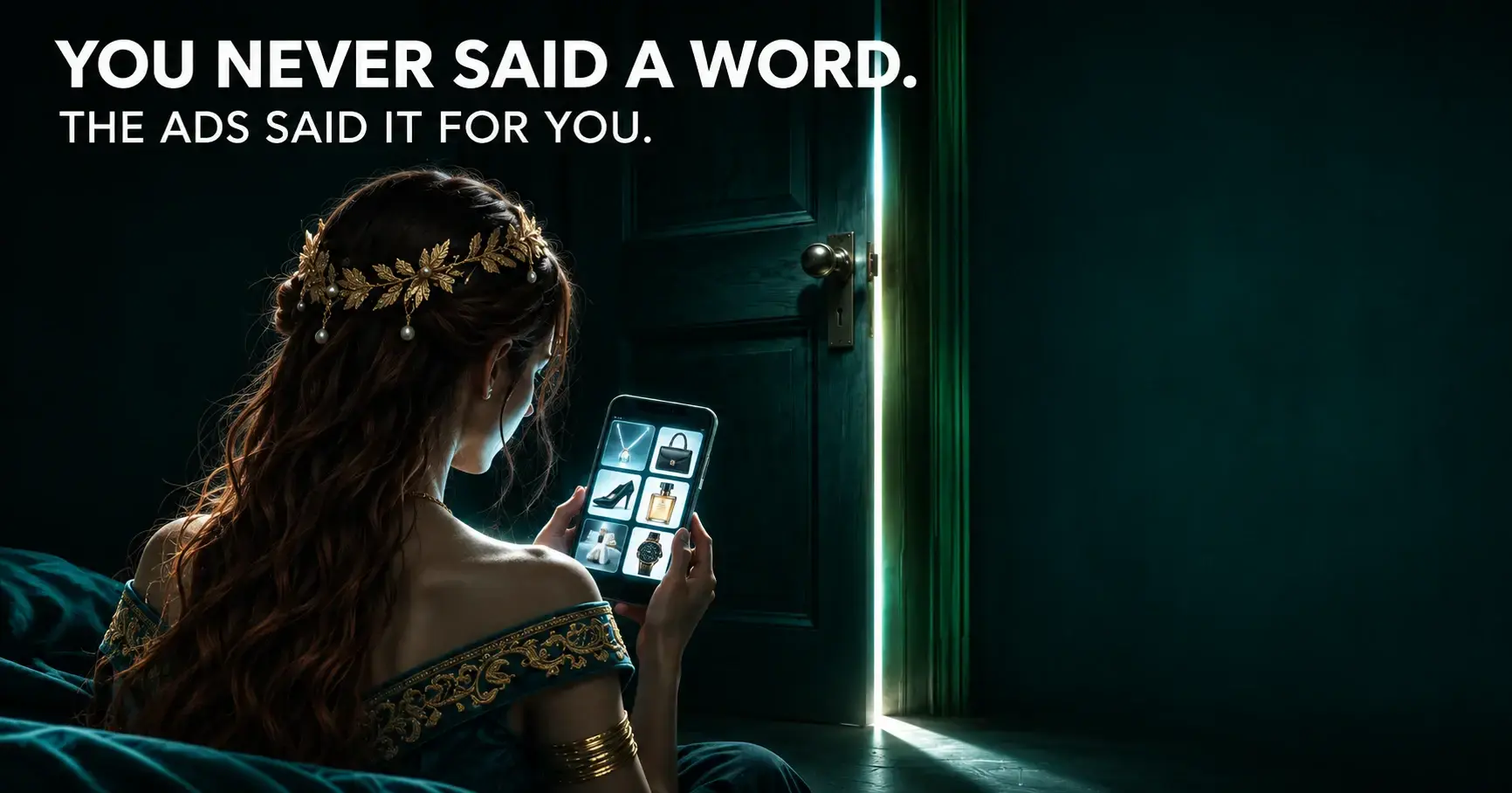
An ad shows up that fits too well. You never searched for it. You never typed it. You never said it out loud. And something in your gut says: how did it know?
You weren’t imagining it. Now there’s proof.
The Proof
In April 2026, researchers published a study called When Ads Become Profiles at the ACM Web Conference.
Here is what they did. They collected more than 435,000 Facebook ads shown to 891 people. Not posts. Not likes. Not searches. Just the ads that landed in front of them.
Then they handed those ads to AI models anyone can use.
The AI guessed each person’s
- Political party.
- Job status.
- Education level
It beat guesses based on census data. It matched or beat human judges doing the same job. It did it 223 times cheaper and 52 times faster than the humans.
And it didn’t need months of watching. One browsing session was often enough.
One honest limit. The study proves that anyone holding your ad stream can read you. It does not prove Facebook runs this exact process on you personally. That should not make you feel better. It means reading you is no longer a platform secret.
It’s a cheap trick anyone can pull.
Feeling One: “Nothing I Can Do About It.”
This is where most people land. AI keeps digging deeper. It already knows everything. Why fight it?
People are starving for answers. And starving people grab whatever’s put in front of them. The feed knows that. It serves more. Here’s the part nobody tells you. The machine isn’t all-seeing. It reads what it’s handed. In this study, they handed it ads.
That’s it. No private messages. No secret files. The ads you were shown became their window into who you are. Every ad is a clue because the system picked each one for someone like you. Stack up enough of them, and the pattern reads like a diary you never knew you were writing.

But look at what that means. The reading is only as good as the input. The input is a stream you can influence. You can open your ad settings and switch off personalized ads where the platform lets you. You can clear the interests it has filed under your name. You can hide the ads that don’t belong to you instead of scrolling past them. You can stop tapping on the ones that bait you. You can browse logged out, or in a separate browser, so the trail doesn’t all pile up in one place. None of it is glamorous. All of it changes what flows through the window.
It won’t make you invisible. It doesn’t have to. It only has to make you harder to read, and a muddier stream gives a muddier reading. So the window is the lever. Change what flows through it, and the reading changes.
Helplessness is a feeling. Exposure is an input. You can’t argue with a feeling. You can change an input.
Feeling Two: “Something Must Be Wrong With Me.”
This is where the other half lands. And shadow work is waiting for them.
Shadow work says: look within. Find the wound. Trace the pattern back to where it started. Own it, name it, and do the slow work of fixing yourself. If something feels wrong, the answer is somewhere in your history, your childhood, your habits, your hidden corners.

That advice was built for a different world. A world where the pressure came from inside you. This pressure didn’t. The profile was built outside you. From ads you never asked to see. By tools you were nudged to accept with a bright button and a buried “no.” Turning inward now means auditing yourself while the real auditor walks free.
You are not broken because you got read. You got read because the system was built to read you.
You can’t heal your way out of a contract you didn’t read.
Shadow work asked: why do I feel watched?
AlchemMyst answers: because you are. Look outward first. Then look in.
The Forbidden Look
There’s an old story from medieval Europe. Melusine married a man named Raymondin on one condition. He must never look at her on Saturdays. One day a week, she asked for privacy. That was the whole deal. In return, she gave him a great deal: a castle, a fortune, and a household of sons. She asked for nothing else, and she told him the terms before the wedding, not after.
He agreed. For years the arrangement held, and everything she had promised came true. Then doubt got into him, the kind that sounds like concern. What was she doing behind that door? He told himself he had a right to know. So he made a hole in the door with his sword and looked. What he saw was the part of her she had asked him not to see. Once he had seen it, he could not unsee it, and he could not take the look back. She transformed and left.
The story is about a contract. The terms were clear. The crime was the look taken without permission.
Now flip it. In this story, you’re not Raymondin. You’re Melusine. You’re the one being looked at. And here’s the twist that should stop you cold.
The researchers collected their data (their looks) with a browser extension. They warn that this same kind of profiling could hide inside extensions people trust. Ad blockers. Coupon finders. Tools that already have permission to see the pages you visit. The tool you installed to protect yourself could be the same one reading you.
You clicked Allow. The window opened. Someone else is now standing in it.
What To Do Instead: The Window Pass
No lawyer required. No tech degree. Fifteen minutes, once a month.
- Open your browser’s extension list. For each one, look at what it can read. If it says “read and change all data on all websites,” it can see your ads too.
- Remove what you can’t explain. If you can’t say what an extension does in one sentence, delete it.
- Check your ad settings. Every major platform shows the interests and categories it has filed you under. Look. That’s how you’re being sorted.
- Read your feed like a report card. Ask one question: what would a stranger conclude about me from this alone?
- Change the input. Starve the signals you don’t want read. Click less. Linger less. Feed it what you choose.
Before you accept anything new, ask the question Melusine would ask:
What am I agreeing to, and who gets to look?
The Bottom Line
Shadow work asks: what’s wrong with me?
AlchemMyst asks: who’s reading me, and what did I sign?
You are not broken.
You are being read.
One of those you can fix by looking inward. The other you fix by looking at the window.
Do not call it consent until you understand the consequences.
Enter the Chamber of Melusine: The Unread Contract.
Take Melusine’s 10-sign Fine-Print Audit and find out how wide your window is.
Want the full toolkit? Grab the Anti-Prompt Pack: 100 Algorithmic Awareness Triggers.
Sources
- When Ads Become Profiles (ACM DOI)
- When Ads Become Profiles (arXiv 2509.18874)
- AlchemMyst: The Age of AI Symptom Glossary
- Notre Dame Medieval Studies: Melusine
- D. L. Ashliman, Melusina
- Edward Worth Library: Melusine
- FTC: Rise in Sophisticated Dark Patterns
- FTC: Bringing Dark Patterns to Light
- OECD: Dark commercial patterns
- Norwegian Consumer Council: Deceived by Design