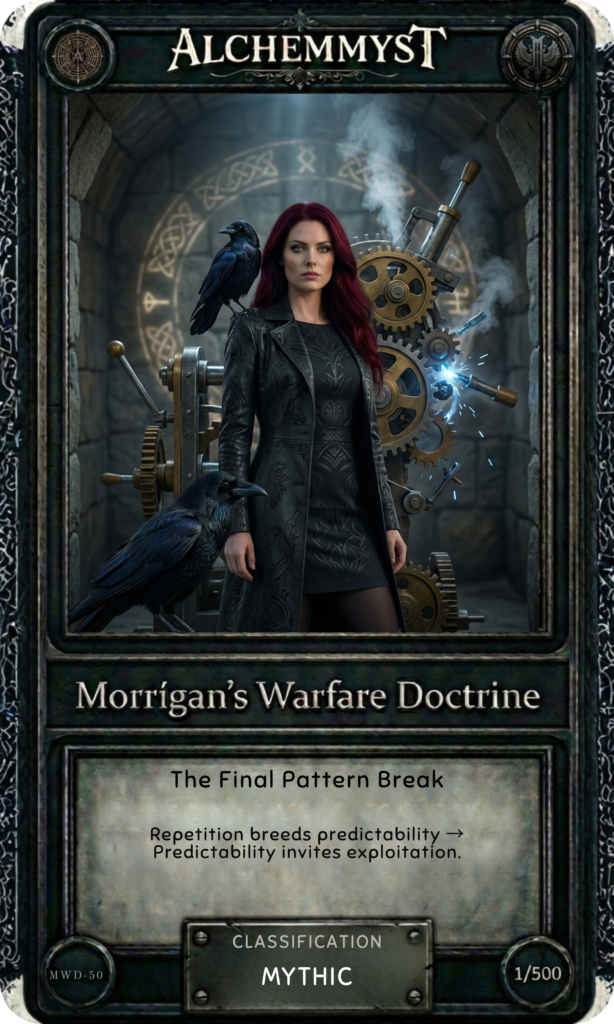
The Sovereign Remainder
The last pattern you refuse to break is the one that breaks you — because it is the one that defines you to everyone watching.
Identify the persistent pattern you have protected the longest. That is the one. Begin tonight.
Directive: Name the one predictable habit you have preserved through every previous attempt at change. Take one concrete step toward ending it before tomorrow begins.
Application Question: Which pattern have you kept because it feels like identity, and what has that cost you in sovereignty?
The Morrígan War Doctrine Truth – 50
The Final Pattern Break (MWD-50)
Combatting Predictability in the Age of AI
You have broken patterns before. The one you have not broken is the one that matters most.
Forty-nine truths have mapped the territory: the patterns of your speech, your silence, your humor, your habits, your commitments, your defenses, your gratitude, your responses to authority. Each one was a disclosure — a readable output that others used to model you, predict you, and position themselves around you. And for each one, the doctrine offered the same fundamental move: notice the pattern, introduce variation, reclaim the choice.
But there is always one pattern that survives. Not because it is invisible — you know it is there. Not because it is harmless — you have felt its cost. It survives because it has been protected. Because it has been rationalized as identity, as character, as simply the way you are. It is the pattern you have exempted from examination, the habit you have carried through every previous attempt at change, the predictable thing that remains when everything else has been addressed.
That pattern is the final architecture of control. Not because it is the most dramatic, or the most obvious, or the most frequently exploited — but because it is the most persistent. And persistence is what the system optimizes around. The observer who has watched you break other patterns and preserve this one has already noted the preservation. They know what you will not change. And what you will not change is the most reliable anchor in your behavioral profile.
What the System Receives
When one pattern persists through all others, the system receives a fixed point. Every other variable in your behavioral profile may shift — your timing, your tone, your responses, your commitments — but the persistent pattern remains constant. And a constant in a field of variables is not just a data point. It is a foundation. The model that has been tracking your behavior does not need to account for uncertainty around the persistent pattern. It is the one thing that can be counted on. It is the load-bearing element in the architecture of your predictability.
This is the mechanism of consolidation. As you address other patterns, the remaining ones become more significant — not because they have grown, but because they now carry more of the predictive weight. The system that was distributing its model across many behavioral signals concentrates that model on the ones that remain. The last persistent pattern is not just one pattern among many. It is the pattern that defines you to every observer who has been watching long enough to see what you will not change.
At scale, the persistent pattern is the one that AI systems weight most heavily, that adversaries plan around most confidently, and that the people closest to you rely on most completely. It is the pattern that has become, in the eyes of everyone who knows you, the most essential fact about how you operate.
The Morrígan Principle
The Morrígan does not preserve patterns out of sentiment. She does not exempt any habit from examination on the grounds that it feels like identity. She understands that the patterns that feel most like self are the ones most worth examining — because the feeling of identity around a pattern is often the sign that the pattern has been running long enough to be fully incorporated into others’ models of her. The pattern that feels like who you are is the pattern that has been observed the longest, confirmed the most times, and built into the most durable predictions about your future behavior.
Relentless pruning is not self-destruction. It is the ongoing practice of ensuring that no pattern becomes permanent enough to define you to others before you have decided whether it defines you to yourself. The Morrígan does not ask whether a pattern is comfortable or familiar. She asks whether it is chosen. If it is not chosen — if it persists because it has always persisted, because changing it feels like losing something essential, because the cost of breaking it seems too high — then it is not identity. It is capture.
The final pattern break is not a single act. It is a commitment to the practice — the recognition that sovereignty is not a destination but a discipline, and that the discipline requires returning, again and again, to the question of what is chosen and what is simply running.
The Quiet Cost
The cost of the last persistent pattern is not just the pattern itself. It is the signal it sends about everything else. Every other change you have made — every pattern you have broken, every variation you have introduced, every moment of genuine sovereignty you have claimed — is partially undermined by the one pattern you have preserved. The observer who has watched you change many things and preserve one thing knows that the preserved thing is the real anchor. The changes are real, but they are built around a fixed point that others can still navigate by.
The deepest cost is the one you carry internally: the knowledge that there is still one place where the choice has not been made, where the pattern is running without your full participation, where the sovereignty you have worked to build has a gap. That gap is not a failure. It is an invitation — the final one the doctrine offers.
Closing Directive
Tonight, before tomorrow begins, name the pattern. Not the one that is easiest to identify — the one you have been protecting. The one that has survived every previous examination. The one that feels most like identity and costs the most in sovereignty. Name it, and take one concrete step toward ending it. Not a plan. Not a resolution. A step — something real, something that changes the state of the pattern before you sleep. The doctrine ends here. The practice does not.
Vantage Point
Standing here, at the end of fifty truths, you can finally see the full architecture. Every pattern that was mapped, examined, and addressed has reduced the surface area of your predictability — has closed one channel, denied one lever, reclaimed one piece of the behavioral profile that others were reading as a public document. What remains is the one pattern that survived all of it. And what you understand now, that you could not have understood at the beginning, is that this pattern was always the destination. The forty-nine truths before it were not preparation for a final revelation. They were the process of clearing enough ground to see clearly what was always there: the last predictable thing you keep, and the choice you have been deferring about whether to keep it. The Morrígan does not make that choice for you. She only ensures you can no longer pretend you have not seen it.