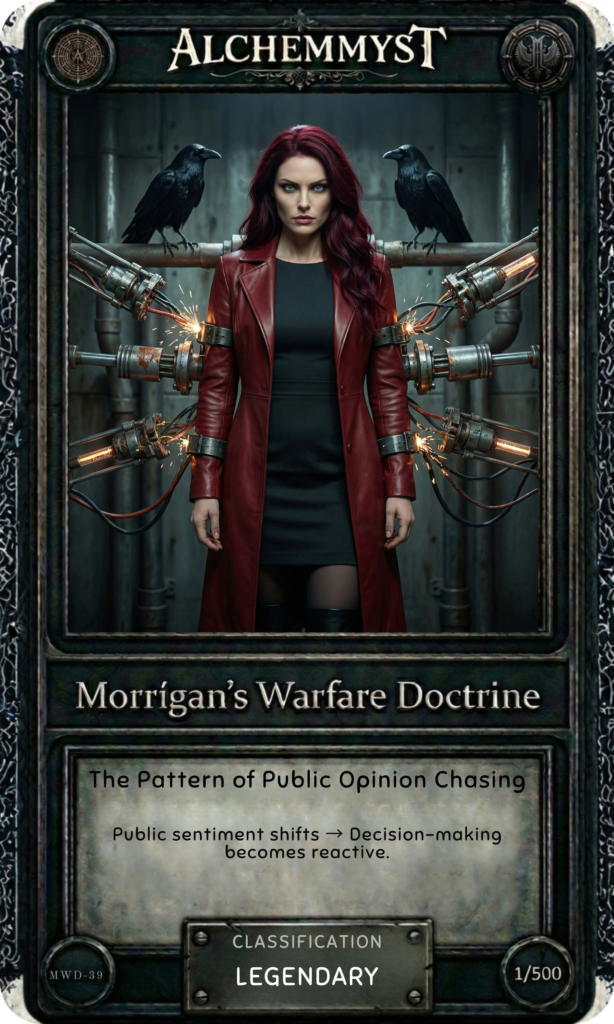
The Scheduled Shift
When you move your position to match the room on a schedule, the room learns the schedule. The shift that feels like social intelligence is, from the outside, a timetable — and timetables are not positions. They are mechanisms.
Independent posture is not stubbornness. It is the refusal to let your stance be operated by external consensus.
Directive: Hold a contrarian or neutral stance once today where you would normally follow consensus.
Application Question: In which conversations or contexts do you shift your position to match the room — and how long has that pattern been visible to the people in those rooms?
The Morrígan War Doctrine Truth – 39
The Pattern of Public Opinion Chasing (MWD-39)
Combatting Predictability in the Age of AI
The moment you agree with the room because the room expects you to, you have handed the room a lever.
This is not about the merits of the position you take. It is about the pattern of how you arrive at it. When you consistently shift toward consensus — in the same situations, at the same pace, under the same social pressure — you have not demonstrated open-mindedness. You have demonstrated a schedule. And schedules, unlike positions, can be operated.
The distinction matters because it changes what is actually at stake. The person who holds a genuine position and revises it in response to compelling evidence is doing something fundamentally different from the person who moves toward the room because the room expects movement. The first is reasoning. The second is performing. And performance, when it is consistent enough, becomes a mechanism that others can trigger on demand.
What the Model Reads
In AI-driven behavioral analysis, stance-shifting in response to social pressure is among the most reliable indicators of influence susceptibility. A model that identifies when you shift, what triggers the shift, and how far you typically move has identified something more valuable than your current position — it has identified the conditions under which your position can be changed. That information is not neutral. It is a map of where to apply pressure, how much pressure to apply, and what kind of pressure produces the fastest result.
At the interpersonal and organizational level, the same map is built through observation. The colleague who has watched you navigate three group discussions knows how much consensus is required before you align. The adversary who has seen your public-facing positions shift in response to trending opinion knows which direction to push and when to push it. They are not responding to your reasoning. They are operating your schedule.
What makes public opinion chasing particularly consequential is that it is socially rewarded. Agreement is frictionless. Consensus is comfortable. The person who aligns with the room is welcomed by the room, and the welcome reinforces the behavior. This is precisely the mechanism: the reward for alignment is social inclusion, and social inclusion is a powerful enough incentive to override independent judgment in most ordinary situations. The pattern does not feel like a vulnerability. It feels like social competence. That is what makes it legible to anyone who is not inside the reward loop.
The Morrígan Principle
The Morrígan does not take the field because the crowd expects her. She takes the field when the field requires her presence, and she leaves when the field no longer does. Her posture is not determined by what the room is doing. It is determined by what the situation actually demands — and those two things are rarely the same.
The doctrine here is not contrarianism for its own sake. Holding a contrary position because it is contrary is simply a different kind of schedule — equally predictable, equally operable. The doctrine is independent posture: the capacity to assess a situation without reference to what the room expects, and to hold or revise a position based on that assessment rather than on the social pressure to align.
In practice, this means introducing deliberate variation into the pattern of your public stances. Not every consensus is wrong, and not every contrarian position is right. The point is that your movement toward or away from consensus should not be predictable from the outside — should not follow a detectable schedule, should not respond to the same triggers in the same way, should not be operable by anyone who has studied the pattern long enough. The adversary who cannot predict when you will align cannot reliably manufacture the conditions for alignment. That uncertainty is the protection.
At the scale of AI-driven influence systems, this matters in ways that extend beyond individual conversations. Recommendation algorithms, sentiment analysis tools, and social proof mechanisms all operate on the assumption that observed behavior predicts future behavior. A user who consistently aligns with trending opinion is a user whose future positions can be shaped by controlling what trends they see. The scheduled aligner is not choosing their positions — they are receiving them, curated and delivered by systems that have modeled the schedule and are now operating it at scale. The content that appears in the feed, the framing of the headline, the sequencing of the social signal — all of it is calibrated to a behavioral profile that the scheduled aligner helped build with every predictable shift. The independent posture is the only posture that is not, in this sense, already occupied by someone else. It is the only posture that requires the system to guess rather than confirm.
Closing Directive
Hold a contrarian or neutral stance once today where you would normally follow consensus. Not because the consensus is wrong, but because the pattern of following it has been visible long enough to be operated — and the first disruption of a schedule is the beginning of an independent posture.
Vantage Point
From here, the schedule is visible in its entirety: the triggers, the pace of movement, the distance traveled toward consensus in each context. What changes when you hold your position is not the outcome of the conversation — it is the confidence of the model. The adversary who expected the familiar alignment encounters instead a position that did not move on cue, and the lever they had prepared does not engage. From this vantage point, independent posture is not stubbornness. It is the refusal to be operated.