The Unstable Advantage
Preparing the same way every time makes your readiness a known quantity — and known quantities can be timed against.
The counter-move is not less preparation — it is preparation that cannot be mapped.
Directive: For one upcoming task or meeting, change at least one element of how you prepare. Vary the angle, the sequence, or the source.
Application Question: What does your preparation routine reveal about how you will show up — and who already knows it?
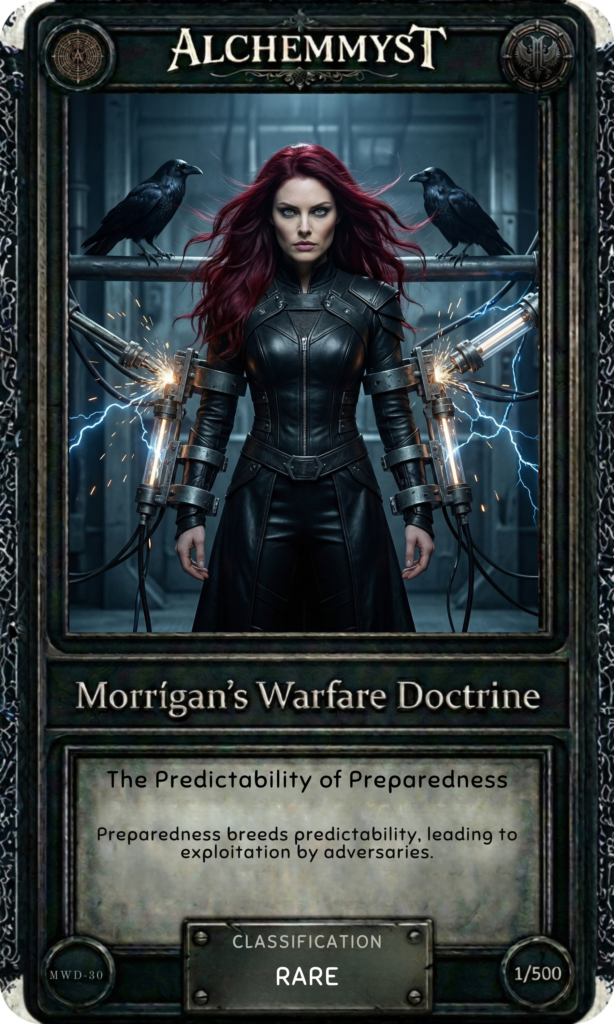
The Morrígan War Doctrine Truth – 30
The Predictability of Preparedness (MWD-30)
Combatting Predictability in the Age of AI
The adversary does not need to outprepare you — they only need to know when and how you prepare.
Preparation is the thing you trust most. It is the discipline that has served you, the ritual that produces confidence, the sequence of steps that gets you ready to perform. You review the same materials. You run the same mental rehearsal. You arrive at the same state of readiness through the same process every time. The consistency feels like mastery. What it is, in practice, is a pattern — and patterns, once observed, become intelligence.
This is the paradox the doctrine names: the very act of preparing thoroughly, when done the same way every time, makes your readiness legible. Legible readiness is not an advantage. It is a disclosed position. The person who knows your preparation routine knows what you will have covered and what you will not. They know the angle from which you will approach the problem, the sources you will have consulted, and the arguments you will have prepared. They know the shape of your readiness before you arrive. And that knowledge is enough to time their move against yours.
Consider what a consistent preparation routine reveals over time. Not just the content of your preparation — the architecture of it. You always prepare the same number of days in advance. You always review the same categories of information. You always enter the room with the same type of confidence, which signals the same type of preparation. The person paying attention across multiple interactions does not need to know what you prepared. They need to know the structure of how you prepared — because that structure tells them what you will have, what you will not have, and where the gap is. The gap is where they move.
In the age of AI, this dynamic scales beyond individual observation. Systems that model performance patterns, preparation behaviors, and readiness signals can construct a profile of your preparation from far less data than you would expect. The consistency you take pride in — the discipline of always being ready in the same way — is exactly the signal that makes you readable. What presents as thoroughness from the inside presents as predictability from the outside. The adversary does not need to match your preparation. They need to model it. And a model built on consistent inputs is a precise model.
This is the asymmetry that makes the pattern dangerous at scale: your preparation is designed to give you an edge, but the edge only exists if it is not already accounted for. The moment your preparation can be anticipated — the moment the adversary knows what you will have and what you will not — the edge disappears. You arrive ready. They arrive ready for you. The preparation that was meant to be an advantage has become the variable that made their counter possible.
The Morrígan does not prepare by ritual. She prepares by reading the field. Before she moves, she assesses — not from a fixed checklist, but from the specific demands of the specific situation. What does this moment require that the last one did not? What angle has not been prepared against? What source has not been consulted? What form of readiness would be unexpected here? These are not the questions of someone who is less prepared. They are the questions of someone whose preparation cannot be catalogued, because they are always responding to the present conditions rather than executing a fixed sequence.
The distinction is between preparation as routine and preparation as response. Routine preparation produces consistent readiness. Response preparation produces appropriate readiness — readiness that is calibrated to what the moment actually requires, not to what the last moment required. The person who prepares by routine arrives ready for the expected encounter. The person who prepares by response arrives ready for the actual one. And because their preparation varied, the adversary’s model of them is already out of date.
What you lose when the routine governs is not thoroughness. You lose the element of the unexpected. A person who always prepares the same way can be anticipated at the table before they open their mouth. The adversary has already accounted for what they will have. They have already positioned their counter. The preparation that was meant to be an advantage has become the map that made the counter possible.
Varied preparation does not mean less preparation. It means preparation that refuses to be catalogued. It means arriving with readiness that was shaped by this situation rather than by the last ten. It means that the model someone built of your preparation style is perpetually one version behind — and in any exchange where timing matters, one version behind is enough to change the outcome.
Closing Directive: Before your next significant task or meeting, change one element of how you prepare. Not the quality — the angle. Consult a source you would not normally consult. Approach the problem from the direction you least expect to need. Vary the sequence. The preparation you do in a new way is the preparation no one has already prepared against.
Vantage Point
Standing here, you can finally see the shape of the counter that was waiting for you — built from every time you prepared the same way and arrived at the same angle. The moment you varied the approach, the counter had nothing to land on. What you are looking at now is not better preparation. It is a preparation that existed outside the model. The adversary arrived ready for the version of you they had already mapped. That version did not show up. The one that did was not in their data.