You’ve felt it. You open an app to kill five minutes and the next thing you know, forty-five minutes are gone. You scroll, and somehow everything on there seems to pull you to the next clip. Nobody sat you down and asked what you wanted to see. It just happened — the way you end up saying yes to plans you didn’t want, or somehow always parking in the same illegal but never-been-caught spot. You’ve probably been calling that a bad habit, or just “how it is now.” It isn’t. It’s the machine. In December 2024, a team of researchers proved exactly how it works with a real test on real accounts.
What it did: It pruned everybody down to the mean. The accounts were fed similar videos, thinner news diets, and up to 40% less diversity in content. Accounts that leaned one way were pushed further that way.
The machine sorted everyone into smaller boxes, because that’s what it’s built to do. This is for revenue predictability in “The Behavioral Futures Market.”
This is Not a Glitch
Researchers created popularity bias. This is where the system trusts you will like whatever’s popular because more people do. Couple this bias with Preference reinforcement (when you click on one thing twice), you are quietly teaching the machine to give you more of exactly that, every time. Combining these two, and you get a feed that keeps narrowing while feeling like it’s giving you more, faster. That’s the machine doing its job. Unfortunately, nothing in the self-help aisle has been built to catch this.
That’s the promise in the headline.
The Feed Trap
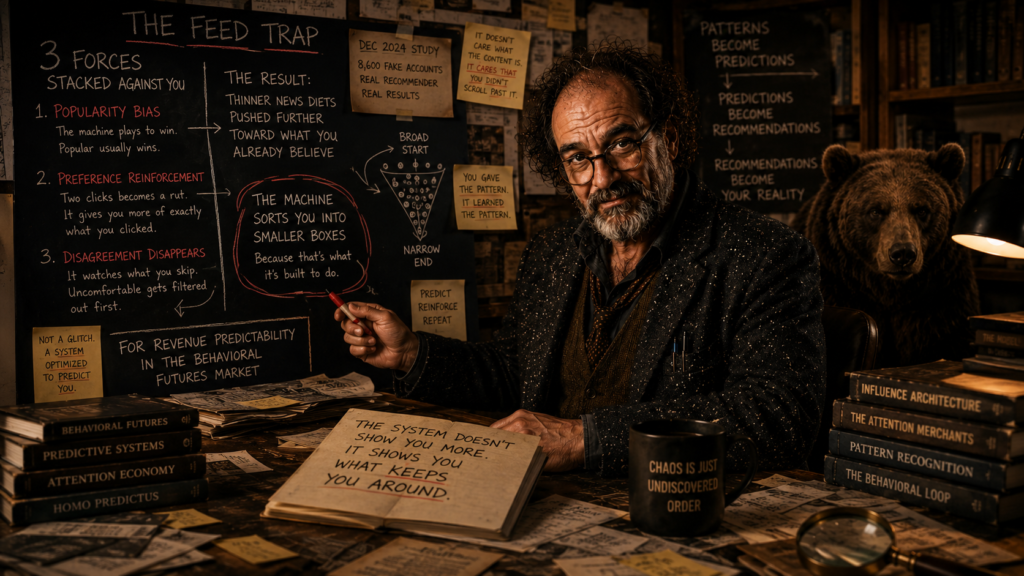
Three things are stacking on top of each other in your feeds, and a real study just measured them.
- The machine plays to win. It’s not chasing what’s true or what’s good for you. It’s chasing whatever’s the safest bet — meaning whatever’s already popular will usually win you over. Your weird, specific interests didn’t get rejected. They just got quietly pushed to the back because the machine wasn’t as sure about them.
- Two clicks becomes a rut. Watch two videos on one topic or one point of view, and the third recommendation leans a little further that direction. Not because you asked for more of it. Because clicking twice reads like a signal, and the machine runs with it.
- Disagreement disappears. The feed watches what you skip. Anything uncomfortable, anything that challenges you, gets quietly filtered out first — because that’s the stuff most likely to make you close the app.
In that December 2024 study, four researchers — Xudong Yu, Muhammad Haroon, Ericka Menchen-Trevino, and Magdalena Wojcieszak — ran this test. They built 8,600 fake accounts out of real people’s actual YouTube watch histories and let the real recommender run on them, untouched, to see what it would do with news and politics. It did what the pattern predicts: thinner news diets, and people who already leaned one way pushed further that way. Their findings were published in PNAS Nexus — a real, peer-reviewed science journal.
The same thing happens with anything else you show a pattern around.
Keep watching long enough, and you notice that you will stop choosing what you see. The machine starts choosing it for you, based on whatever kept you around last week.
Here’s what that looks like outside a lab. Say you spend one weekend watching home-renovation videos because you’re about to move. A month later, your whole feed has rearranged itself — contractor ads, “five mistakes everyone makes,” urgent nonsense about resale value you never asked about. Nobody decided you were “a renovation guy” now. The machine logged a strong signal and ran with it, the same way it would with a political opinion, a diet, or a conspiracy theory. It doesn’t care what the content is. It only cares that you didn’t scroll past it.
Why Shadow Work Never Caught This
Chances are, if you’ve ever tried to figure out why you can’t focus anymore, or why you keep scrolling, or why your patience is shorter than it used to be, somebody pointed you inward — look at your childhood, sit with your discomfort. That’s Shadow Work, in short: the idea that the pattern keeps coming back because there’s something in you it’s trying to show you.
Shadow Work was good, honest work for what it was built to handle. What it wasn’t built to handle is this. Shadow Work was designed decades before AI manipulation, before Behavioral Futures Markets, before surveillance capitalism existed as a business model. It has no answer for any of them, because none of them were on the map yet.
In The Age of Surveillance Capitalism, Shoshana Zuboff named the mechanism plainly: human experience is claimed as raw material, turned into data, and turned into predictions about what you’ll do next — and those predictions are sold in what she calls behavioral futures markets. Your hesitation isn’t just observed anymore. It’s inventory, with a buyer already lined up.
Shadow Work assumes a wound, once named and sat with, stays resolved. That held up fine against ordinary life. It doesn’t hold up against a system built to keep finding whatever still gets a reaction out of you — including the wound you already did the work on. People are tired of doing that work, believing it’s closed, and then watching an algorithm reopen it anyway. Not to heal you. To predict you.
That’s the actual difference, and it’s not small. Therapy and journaling assume you’re the only one in the room. In the Age of AI, you’re not. There’s a second party in every scroll, and it has a business model.
The Guardian Who Already Named This Pattern
History warned us about this. Centuries before anyone ran a study that was buried in a 2024 research paper, Homer and his crew had to conquer the Sirens.
Sailors would hear a beautiful song out at sea, mesmerized by the sound, they all would stop what they were doing and listen. Before they knew it, they had crashed upon the rocks. The songs never lied to them. It only told of things they wanted to hear. Gold, riches, beautiful women were at their intended destination. The sailors listened until agreement felt like the truth. Many died believing those songs.
The fix she offers is the same one researchers just proved actually works: interrupt it. Say it out loud if you need to —
“Not today, Siren. I’m thinking for myself.”
Then close the app, pick a different source, and go back to whatever you were actually doing before the feed pulled you off course.
Proof This Isn’t Permanent

Here’s the part nobody in self-help ever had access to: the same researchers didn’t just prove the problem exists. They tested whether it could be fixed — on real people.
For three weeks, 2,142 YouTube users, recruited for the study, got split three ways.
- One group: nothing changed.
- One group: a banner popped up reminding them why it’s good to see different viewpoints.
- One group: researchers quietly fed their YouTube algorithm balanced, verified news videos in a background browser tab — the person didn’t do anything differently at all.
The quiet background trick worked, and it worked big. News recommendations went up by almost triple in one version of the test, and by more than five times as much in another. Recommendations across the political spectrum — not just one side — rose by 20 to almost 60 percent. People actually watched more of it too, and the gap between what one side saw and what the other side saw shrank, especially for people leaning conservative.
The banner did nothing. Not “a little.” Nothing — that’s the researchers’ own word for it.
Read that again: telling people to want more balance didn’t move anything. Actually changing what fed the algorithm did, immediately.
Source: Yu, Haroon, Menchen-Trevino, and Wojcieszak, “Nudging recommendation algorithms increases news consumption and diversity on YouTube,” PNAS Nexus, Vol. 3, Issue 12 (December 2024).
What To Actually Do About It
Knowing the trick doesn’t disarm it. And the research already ruled out the easy way out — a gentle reminder to “be more open-minded” does nothing. What works is changing the actual input, not how aware you feel.
You don’t need to quit the app. You need to mess with its diet, on purpose:
Read the comment you’d normally scroll straight past. Follow one account you don’t agree with, and actually let their posts show up instead of muting them. Search for something instead of waiting for the feed to hand it to you. Pick a source you wouldn’t normally pick — more than once, on purpose.
None of that requires deleting anything. It requires choosing what goes in, instead of eating whatever gets served.
If you want somewhere smaller to start than a whole book, The Sovereignty Leak Audit is a 7-day audit built for exactly this — it shows you where your attention, your opinions, and your judgment are already leaking out, before you read another page of anything.
Why This Matters Right Now
Ten years ago “the algorithm” meant a list, sorted once, shown to basically everybody the same way. Now it’s a system rewriting your specific feed based on a hesitation half a second long, before you even finish scrolling past something. That kind of recommender is the default now, not the exception, across pretty much every app you use — and it moves faster and hides its tracks better than the old version ever did.
The trick got sharper. The fix didn’t get harder to match it. A real study already proved the fix is cheap and doesn’t need some big technical overhaul — a platform can flip that switch on its end, or you can flip it yourself, by hand, starting right now.
People Also Ask
Why does my feed feel like everybody agrees with me?
Because the system trims out whatever makes you uncomfortable and gives you more of whatever you clicked twice — not because your own opinions calcified on their own.
Can I fix this myself, or does the platform have to do it?
Either one works — as long as something actually changes what’s feeding the algorithm. In the real 2024 study, just telling people to want more balance did nothing. Changing what the algorithm was fed worked immediately. Same logic applies if you’re the one doing the changing.
Isn’t this just a filter bubble?
Close, not identical. A filter bubble is what you end up seeing. What’s described here is the machinery that builds the bubble in the first place.
Doesn’t Shadow Work already cover this?
No — it was built decades before AI manipulation, Behavioral Futures Markets, or surveillance capitalism existed, so it has no answer for a system that reopens wounds you already resolved, not to heal you, but to predict you. Shadow Work wasn’t built for this fight, and it doesn’t have what this fight requires.
What’s the fastest way to tell I’m stuck in one of these loops?
Notice the moment everything in your feed already agrees with you. That comfortable feeling isn’t a coincidence. That’s the signal.
You’re Not Broken, You’re Unarmed
If it can be measured, it can be interrupted. If it can be interrupted, it can be reversed.
You gave AI the pattern. It learned how to use it against you. You’re not broken. You’re unarmed. Let’s fix that. The Sovereign War begins.
→ alchemmyst.com/sovereign-war