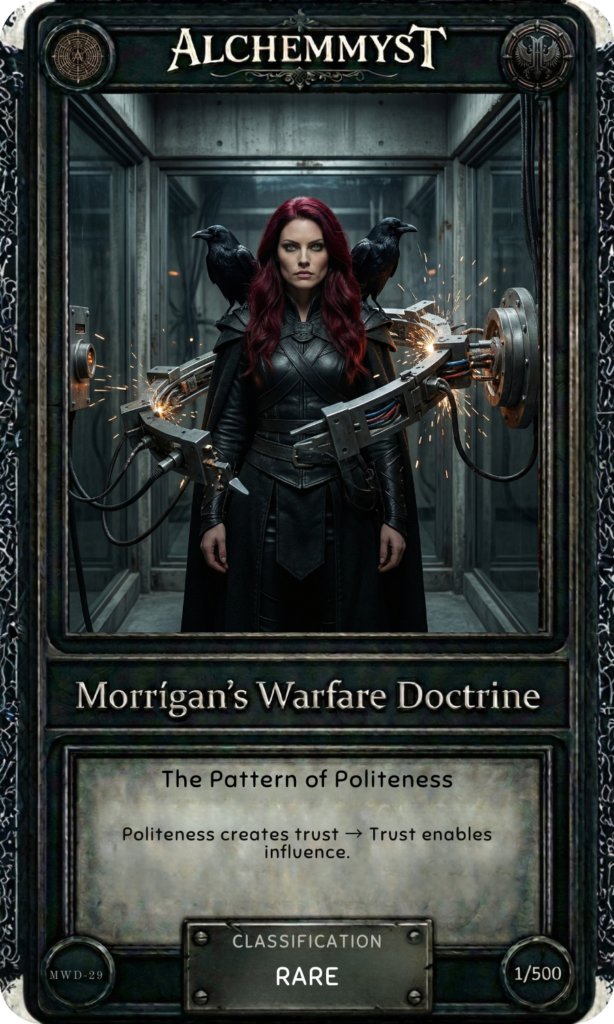
Calibrated Courtesy
Automatic politeness is not civility — it is a compliance signal others have learned to trigger.
The counter-move is not rudeness — it is the polite response that does not yield.
Directive: In one interaction today, be fully courteous and hold your position completely. Let the manner and the boundary coexist.
Application Question: When did your politeness cost you something you did not intend to give?
The Morrígan War Doctrine Truth – 29
The Pattern of Politeness (MWD-29)
Combatting Predictability in the Age of AI
The please and thank you arrived before you decided whether to agree.
This is the pattern no one names because it wears the face of virtue. You were raised to be polite. You were rewarded for it. The smooth exchange, the gracious response, the absence of friction — these became the markers of someone who is easy to work with, trustworthy, safe. And so the habit formed: when someone asks, you soften. When someone pushes, you accommodate. When the social temperature rises, you reach for courtesy the way you reach for a tool that has always worked. What you did not account for is that the tool has been observed. And observed tools become levers.
The pattern of politeness is not a character flaw. It is a social technology that was built for a specific purpose — to reduce friction, to signal goodwill, to make cooperation possible. In the right context, it is exactly that. The problem emerges when the technology runs automatically, when the polite response fires before the decision has been made, when courtesy becomes the default output regardless of what the input actually deserves. At that point, politeness is no longer a choice. It is a reflex. And reflexes can be triggered.
Consider what the pattern signals to the people around you. Not the warmth of it — the functional data. You always say yes before you say no. You always soften a refusal with an apology. You always match the other person’s tone rather than setting your own. You never let discomfort land without immediately moving to resolve it. The pattern is consistent enough to be anticipated. And once it can be anticipated, it can be engineered. The person who wants a concession from you does not need to argue for it. They only need to create the social conditions that trigger your courtesy — a slightly elevated tone, a disappointed expression, an implied expectation — and your reflex does the rest.
This is the mechanism that makes habitual politeness a vulnerability in the age of AI. Systems that model human behavior do not evaluate the quality of your manners. They evaluate the predictability of your responses. A person who reliably softens under social pressure, who consistently accommodates when the temperature rises, who never allows courtesy and boundary to occupy the same sentence — that person is not being read as kind. They are being read as compliant. And compliance, once modeled, can be reproduced on demand.
The Morrígan is not impolite. She is calibrated. She understands that courtesy is a form of communication — and like all communication, its power depends on it being chosen rather than automatic. When she is gracious, it is because the moment warrants grace. When she holds her position, she does so without abandoning civility. The manner and the boundary coexist in her because she has separated the two things that most people have fused: the form of the response and the content of it. She can say no with warmth. She can decline with precision. She can be entirely courteous and entirely immovable in the same breath — and the combination is disorienting to anyone who expected the politeness to carry a concession inside it.
This is the distinction the doctrine draws: calibrated courtesy versus automatic yielding. Calibrated courtesy is not the absence of warmth. It is warmth that does not come pre-loaded with compliance. It is the polite response that does not automatically soften the position behind it. It is the manner that remains consistent while the content of the response is determined by the situation, not by the social pressure of the moment. The person who has mastered this is not cold. They are simply unreadable in the specific way that matters — you cannot predict, from the tone of their response, whether they are about to agree or decline.
What you lose when the automatic pattern governs is not just individual concessions. You lose the signal value of your actual agreement. When you always accommodate, your yes means nothing — because it was never in doubt. The person across from you did not earn your agreement. They simply applied the right social pressure and waited for the reflex to fire. Your courtesy became the mechanism of your compliance, and neither of you chose it.
Closing Directive: The next time politeness rises automatically, pause before it carries a concession with it. Keep the manner. Examine the content. The courteous response and the firm position are not opposites. Let them occupy the same sentence, and watch what the other person does when the lever they pulled did not open the door they expected.
Vantage Point
Standing here, you can finally see the architecture of the exchange — not the warmth of it, but the wiring beneath it. Every automatic accommodation was a door that opened on schedule. The moment the manner stayed, and the concession did not arrive, the script broke. What you are looking at now is not the absence of civility. It is the first time your politeness belonged entirely to you — not to the reflex, not to the social pressure, not to the model someone else built of your responses. The lever was pulled. The door did not open. That is the whole doctrine.