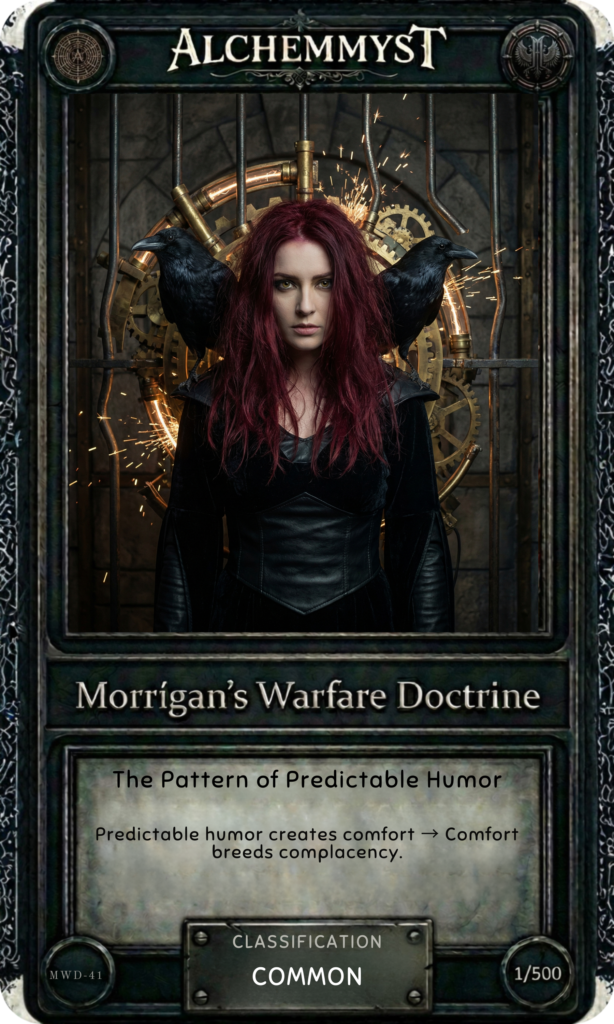
The Chosen Laugh
The joke that arrives on cue is a map of what you will not face.
Humor chosen deliberately protects; humor fired reflexively exposes.
Directive: Resist the reflex once — meet the moment without the joke.
Application Question: What topic do you consistently deflect with humor, and what does that tell you?
The Morrígan War Doctrine Truth – 41
The Pattern of Predictable Humor (MWD-41)
Combatting Predictability in the Age of AI
The laugh that arrives before you decide to laugh is not yours — it belongs to the pattern.
Most people do not think of humor as a vulnerability. They think of it as a gift, a social lubricant, a way of being liked. And it can be all of those things. But when humor becomes reflexive — when the joke fires before the thought forms, when the deflection arrives on schedule — it stops being a choice and becomes a signature. And signatures are readable. And readable signatures are exploitable.
The mechanism is straightforward. Every time you use humor to exit a difficult topic, you teach the people around you two things simultaneously: that the topic is difficult for you, and that humor is the key that unlocks your retreat. The joke does not protect you from the subject. It marks the subject as protected. It draws a circle around the territory you will not enter directly, and it does so in a way that is socially acceptable, even charming. Nobody calls it avoidance. They call it your sense of humor. But the function is the same.
This is not an argument against humor. Humor is one of the most sophisticated tools in human communication — it can disarm, reframe, reveal, and connect in ways that direct speech cannot. The Morrígan is not humorless. She is precise. The distinction she draws is not between humor and seriousness. It is between humor chosen and humor fired. One is a weapon. The other is a tell.
The external observer — the adversary, the negotiator, the system — does not need to analyze your words to find the pattern. They need to notice when the joke arrives. If it arrives at the same moment, on the same topics, in the same register, the pattern is already mapped. They know which subjects produce the deflection. They know that pressing those subjects will generate the laugh and the exit. They know that the laugh is not engagement — it is withdrawal wearing a smile. And once they know that, they can use the subject as a pressure point, pressing until the joke arrives, and then pressing past the joke into the territory you have been protecting.
At the scale of AI-driven systems, this pattern is not difficult to detect. Sentiment analysis, topic modeling, and behavioral pattern recognition can identify deflection signatures across thousands of interactions. The person who consistently shifts register — from direct to humorous — when certain topics arise is not anonymous. They are a data point with a mapped avoidance architecture. The system does not need to understand the joke. It needs to notice the pivot. And the pivot, repeated across enough interactions, becomes a reliable prediction: introduce this topic, receive this response, route the influence through the gap the humor creates.
This is not a theoretical risk. Recommendation systems, persuasion platforms, and adversarial negotiators all operate on the same principle: find the exit, use the exit, expand the exit. The reflexive joke is an exit. It is socially smooth, emotionally comfortable, and functionally identical to a retreat. The difference between the person who uses humor strategically and the person who uses it reflexively is not visible from the outside — until the pattern is long enough to map. And in most cases, by the time someone is using your humor pattern against you, the map has been complete for years.
The Morrígan teaches something more demanding than simply being serious. She teaches the pause before the response — the moment between the trigger and the reflex where a choice can be made. Not every difficult topic requires direct confrontation. Not every moment of tension requires a joke. The question is whether the response is chosen or automatic. If it is automatic, it is not yours. It is the pattern’s. And the pattern is serving whoever learned to read it.
The cost of reflexive humor is not that people stop finding you funny. It is that the people who matter — the ones with something at stake in the interaction — stop taking your humor at face value. They learn to read through it. The laugh becomes a signal, not a response. And the moment your laugh becomes a signal, you have lost the initiative in every conversation where that signal appears.
Hold the laugh once. Not forever — once. Notice what is underneath it. Notice whether the topic you were about to deflect is one you have been deflecting for years. Notice whether the humor was protecting you or protecting the other person from your actual position. The Morrígan does not laugh to escape. She laughs when the laugh is the sharpest thing in the room. Everything else is silence.
Vantage Point
Standing here, you can finally see the map your humor drew — every reflexive joke a marker on the territory you refused to enter directly. The adversary did not need a confession. They needed the pattern, and the pattern was generous. What is visible now is not the joke itself but the gap it was covering: the specific subject, the specific moment, the specific pressure point that the laugh was trained to seal. You are no longer standing inside the deflection. You are standing outside it, holding the map, deciding for the first time which territory is actually worth protecting — and which was only ever habit.