The Strategic Variation
Spot where your consistency has become a liability.
Variation with intent is the only kind that costs the model something it cannot recover.
Directive: Change one predictable element of how you show up today — not randomly, but deliberately.
Application Question: Where are you easiest to forecast?
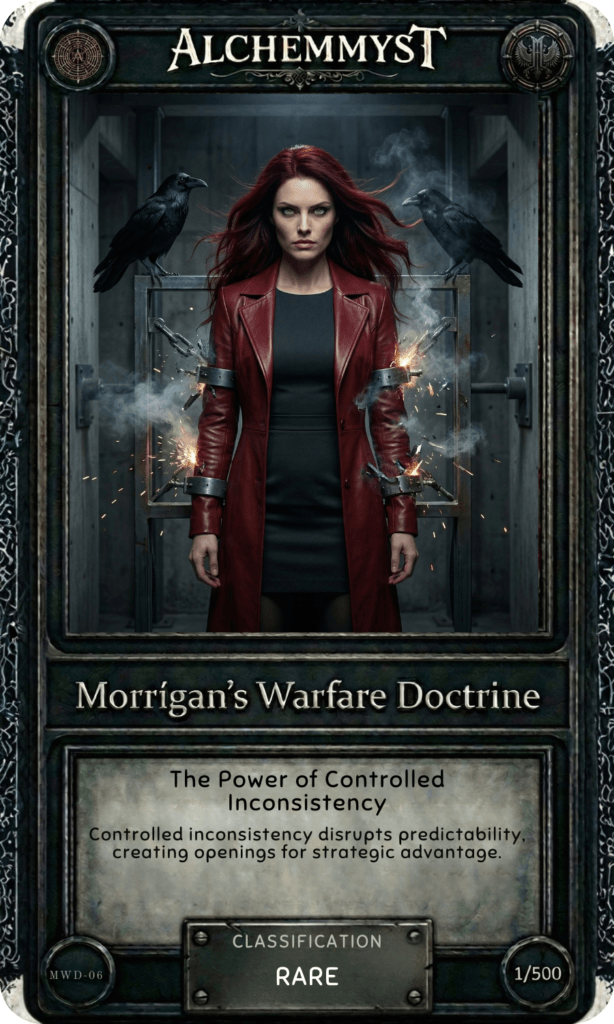
The Morrígan War Doctrine Truth – (MWD-06)
The Power of Controlled Inconsistency
Combatting Predictability in the Age of AI
Inconsistency has a reputation problem.
It has been framed as unreliability, as instability, as the quality of someone who cannot be trusted or counted on. And in certain contexts, that framing is accurate. But there is a version of inconsistency that is none of those things — a version that is precise, deliberate, and among the most powerful tools available to anyone who understands how predictive systems work.
The doctrine does not teach chaos. It teaches controlled variability. The difference between the two is the difference between noise and strategy.
What Predictive Systems Actually Require
A predictive model does not need to know everything about you. It only needs enough stable data points to construct a reliable forecast. Give it three consistent responses to the same category of stimulus, and it begins to build. Give it ten, and the model firms up. Give it a hundred, and you have effectively handed over your next move in advance, every time, without being asked.
The model’s vulnerability is not complexity. It is instability. A pattern that will not stabilize cannot be reliably forecast. And a forecast that cannot be made reliably is a forecast that cannot be acted upon. This is the precise mechanism that controlled inconsistency exploits — not by overwhelming the model with noise, but by denying it the stability it requires to function.
You do not need to become unpredictable in every dimension. You only need to introduce enough deliberate variation in the right places that no clean model can be assembled. One variable shifted with intention is enough to compromise the architecture of the entire prediction.
The Distinction That Changes Everything
The word that carries all the weight in this doctrine is controlled. Randomness is not the goal. Randomness is as readable as consistency — it simply produces a different kind of model, one built around the absence of pattern rather than its presence. True randomness is its own signature.
Controlled inconsistency is something else entirely. It is the deliberate choice to respond differently to the same category of moment — not because you are confused or unstable, but because you have decided that your previous response has become a liability. It is a variation with intent. It is the act of choosing which version of yourself shows up, rather than allowing the default to decide.
This requires a quality that the doctrine returns to repeatedly: awareness. You cannot vary what you cannot see. The controlled inconsistency that disrupts a model is always downstream of the visibility that identified the pattern in the first place. See the pattern. Choose the variation. Execute with precision. That sequence is the entire practice.
The Morrígan as Precision Disruptor
The Morrígan was not chaotic. Chaos does not win battles — it simply creates conditions that neither side can navigate. What the Morrígan practiced was something far more disciplined: she appeared in the form that the moment was least expected, not arbitrarily, but because she had read the battlefield and understood what it was prepared for.
Her power was not in being unknowable. It was in being known just enough to generate an expectation — and then refusing to meet it. That refusal, timed precisely and executed with full awareness, is what collapsed the confidence of those who thought they had her mapped. The model they had built was accurate. She simply declined to confirm it.
This is the doctrine’s most sophisticated instruction. It does not ask you to be a different person. It asks you to be the same person who occasionally, deliberately, shows up in a form the model did not prepare for. The variation does not need to be large. It needs to be intentional. Intentional variation is the only kind that costs the model something it cannot recover.
The Closing Directive
You do not need to become someone else to become unreadable. You only need to choose, in one deliberate moment, not to be what the situation already expects.
That choice — small, precise, and fully yours — is the disruption the model cannot account for.
The Morrígan did not fight the battlefield’s expectations. She simply refused to satisfy them.
Vantage Point
Standing here, you can see the model’s failure in real time. The expectation was set. The cue was given. And then the anticipated data point did not arrive. From this position, you can observe the specific moment the predictive structure stalled — the pause, the recalibration, the brief absence of the smooth, frictionless processing that only happens when a system is operating on confirmed data. Your variation did not confuse the model. It denied the model the one thing it cannot function without: a stable pattern to extrapolate from. From here, the difference between randomness and controlled variability is clear. Randomness generates its own signature. What you just did left no signature at all.