The Private Calibration
Every public declaration is a forecast others can hold you to — and use to steer you.
Calibrate privately before you declare publicly, and you keep the future yours to navigate rather than a schedule others have already read.
Directive: Identify one intention you would normally announce. Keep it private today. Work it first. Declare it, if at all, only after it is already in motion.
Application Question: Which of your public commitments were made before you had decided — and who benefited from the announcement more than you did?
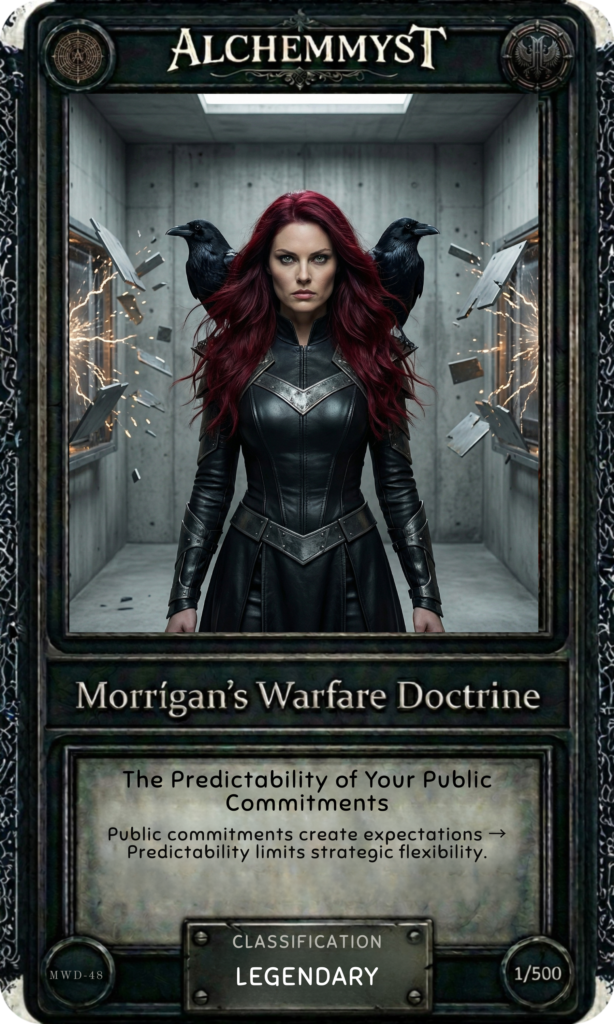
The Morrígan War Doctrine Truth – 48
The Predictability of Your Public Commitments (MWD-48)
Combatting Predictability in the Age of AI
The moment you announce an intention publicly, you have handed others a map of your future.
A public commitment is not just a statement of what you plan to do. It is a forecast — a legible, retrievable record of where you are headed, when you intend to arrive, and what you have staked on the outcome. The audience that receives that forecast does not just witness it. They use it. They build their own plans around your declared trajectory. They know when to expect you to be occupied, when to expect you to be stretched, and when to expect you to be vulnerable to the pressure of your own public word.
This is the amplification effect of visibility. A private commitment is a personal obligation — it operates between you and your own standards. A public commitment is a social contract — it operates between you and everyone who heard it. The social contract is not neutral. It creates external pressure that can be applied by anyone who holds the record of your declaration. And the pattern of your public commitments — the recurring themes, the consistent timing, the predictable categories of intention you announce — is a map of your future that others can read before you have lived it.
The problem is not that public commitments create accountability. Accountability is real and often useful. The problem is that the pattern of your public declarations is a data source, and data sources get read. When you consistently announce the same categories of intention, in the same circumstances, with the same framing, the observer learns not just what you plan to do — they learn how to position themselves relative to your declared trajectory. They learn when to make their move, when to apply pressure, and when to invoke your own words to steer you toward an outcome that serves them.
What the System Receives
When your public commitments are predictable, the system receives a legibility amplification. The observer does not need to infer your intentions — you have stated them. The AI model tracking your behavioral history does not need to model your future — you have declared it. The colleague who knows you always announce your next project before you begin it has already positioned themselves to be involved before you have decided whether you want them there.
Visibility is leverage — but the leverage belongs to the observer, not the declarer. Every public commitment you make is a constraint you have placed on your own future freedom. The constraint may be worth making. But the pattern of making it — the habitual announcement, the reflexive declaration, the social media post that goes up before the work has begun — is a pattern that others have learned to read and plan around.
The specific mechanism is this: a public commitment, once made, is held by everyone who witnessed it. You cannot revise it quietly. You cannot change course without the revision being visible. The social cost of departing from a public declaration is real, and others know it. That cost is a lever. The person who reminds you of your public commitment at the moment you are considering a change of direction is applying that lever — and they can do it because you handed it to them when you announced.
The Morrígan Principle
The Morrígan calibrates privately before she declares publicly — and often, she does not declare at all. Her intentions are not a public document. Her future is not a forecast she has distributed to an audience. She understands that the power of an intention is in its execution, not its announcement, and that the announcement — before the work is done — is a disclosure that reduces her freedom to navigate.
Private calibration is the practice of working an intention before announcing it. Not because secrecy is inherently valuable, but because the announcement before the work is the moment when the future becomes legible to others and the pressure of the public record begins to constrain your choices. When you have already done the work — when the intention is already in motion, already past the point of easy reversal — the announcement is a report rather than a forecast. A report cannot be used to steer you. A forecast can.
The specific practice is to identify the category of intention you habitually announce before beginning — the project declaration, the goal post, the public commitment that goes out before the first step is taken — and hold one instance of it private. Work it first. Announce it, if at all, only after it is already in motion.
The Quiet Cost
Every time you announce an intention before you have begun it, you create a public record that constrains your future choices and hands others a lever they can apply at any moment. The cost is not the commitment itself — it is the visibility of the commitment before it is real. The announcement before the work is a forecast, and forecasts can be used against you by anyone who holds the record.
The compounding cost is attentional. A public commitment creates an audience that expects delivery, and the expectation of that audience is a weight you carry while doing the work. The weight is not always useful. Sometimes it is simply a distraction — a performance obligation layered on top of the actual task, consuming attention that could have gone into the execution.
Closing Directive
Today, identify one intention you would normally announce. Keep it private. Work it first. Let the declaration, if it comes at all, be a report on something already in motion rather than a forecast of something not yet begun. The future that has not been announced is the future that remains entirely yours to navigate. One private intention is enough to begin closing the map others have been reading as a schedule.
Vantage Point
Standing here, you can finally see that your public commitments were not just statements of intent — they were instruments others were using to navigate around you. Every announcement you made before the work began was a forecast that reduced your freedom to change course, a lever that could be applied by anyone who held the record of your declaration, and a data point in a pattern that made your future legible before you had lived it. What you are looking at now is the architecture of that legibility: the specific categories of intention you announced, the specific timing of your declarations, the specific audiences that received them and built their plans accordingly. The move from here is not to become silent about everything. It is to calibrate privately first — to ensure that when you declare, you are reporting on something real rather than forecasting something that others can now use to steer you.