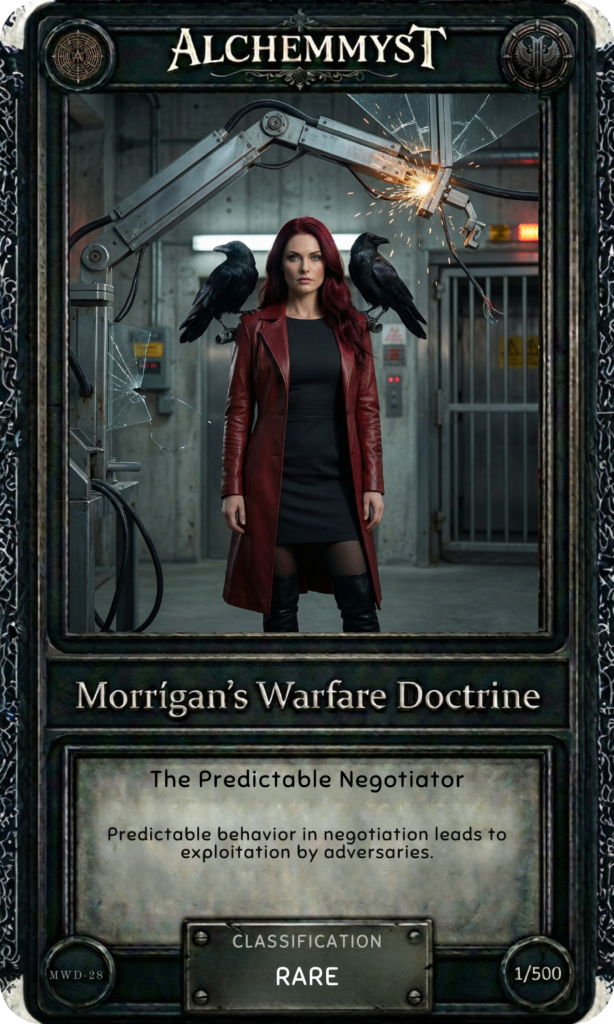
The Uncatalogued Tactician
A negotiation style that never changes is a script the other side has already rehearsed.
The counter-move is not aggression — it is variation: deploy the tactic they have not seen from you.
Directive: In your next negotiation, use one approach you rarely or never use and observe how the dynamic shifts.
Application Question: What is the one move your counterparty has learned to expect from you — and what would it cost them if it never arrived?
The Morrígan War Doctrine Truth – 28
The Predictable Negotiator (MWD-28)
Combatting Predictability in the Age of AI
Your counterparty is not just listening to what you say — they are cataloguing how you negotiate.
Every time you open with the same anchor, concede at the same threshold, or fall silent at the same pressure point, you are not just making a deal. You are teaching. You are demonstrating the shape of your tactics, the sequence of your moves, the exact conditions under which you will yield or hold. The first time, it is a negotiation. The second time, it is a pattern. By the third time, it is a script — and the other side has already read it.
This is not a failure of intelligence. It is a failure of variation. Most people negotiate from a fixed repertoire — a small set of approaches that worked once and became default. The anchor they always open with. The silence they deploy when they want to create pressure. The concession they offer when they sense the deal is close to breaking. These are not bad tactics. They are effective tactics. The problem is that effectiveness, repeated without variation, becomes predictability. And predictability, in any exchange where someone is paying attention, becomes a liability.
Consider what the other side accumulates across multiple interactions. Not just the outcome of the last deal — the behavioral data behind it. They know you always anchor high and then move. They know you respond to silence with a counteroffer rather than holding your position. They know that when you mention a deadline, it is usually real, and when you mention a competing offer, it usually is not. They have not studied you deliberately. They have simply paid attention to enough exchanges to build a working model. And now they are not negotiating against your position. They are negotiating against your pattern.
In the age of AI, this dynamic is no longer limited to experienced counterparties with long memories. Systems that process negotiation transcripts, communication patterns, and behavioral data can construct that model from far fewer interactions — and with far greater precision. The pattern you repeat across three conversations may be enough. The tactic you rely on in every high-stakes exchange is already a known variable. What was once a learned advantage becomes, at scale, a predictable input.
This is the asymmetry that the doctrine names: you are negotiating in real time, while the model being used against you was built across every prior exchange. You arrive with your best move. They arrive with a counter to your best move, already prepared. The gap between those two positions is not intelligence or experience. It is the cost of repetition. Every time you varied nothing, you narrowed the distance between your tactics and their preparation. By the time you reach the table, the negotiation may already be over.
The Morrígan does not negotiate from a fixed script. She reads the field before she moves on it. Where others arrive at the table with a strategy — a sequence of moves prepared in advance — she arrives with a range. She knows the tactic she will use, but she has not decided which one until she has read the room. The anchor, the silence, the concession, the hard stop — each is available to her, and none is automatic. What she deploys depends on what the moment requires, not on what worked last time. This is not improvisation. It is preparation at a higher order: not preparing the move, but preparing the capacity to choose the move.
The distinction matters because it is the difference between a negotiator who is effective and a negotiator who is uncatalogued. The effective negotiator wins deals. The uncatalogued negotiator wins deals and remains unreadable — which means the next deal begins on different terms. The counterparty cannot prepare a counter to a move they cannot predict. They cannot neutralize a tactic they have not yet seen. Every time you vary your approach, you reset the model. You force the other side to negotiate in real time rather than from a prepared script of their own.
What you lose when the pattern governs is not just individual deals. You lose the element of surprise — which, in any exchange where leverage matters, is one of the most valuable assets you hold. A negotiator who can be anticipated has already surrendered a portion of their leverage before the conversation begins. The other side has already prepared the counter. The move you were planning to make has already been neutralized. You are not negotiating. You are executing a script that both sides have already read.
Closing Directive: Before your next negotiation, identify the tactic you always use — and set it aside. Not permanently. Just this once. Use the move that is least expected from you, and watch what the other side does when the script they prepared does not arrive. That moment of recalibration is the space where your leverage lives.
Vantage Point
Standing here, you can finally see the negotiation that was never about the terms. It was about the pattern — yours, mapped and prepared against before you arrived. The moment you varied the approach, the prepared counter had nothing to land on. What you are looking at now is not a better deal. It is the evidence that the model they built of you just became obsolete. The next table begins with no map. That is the only position from which you negotiate on your own terms.