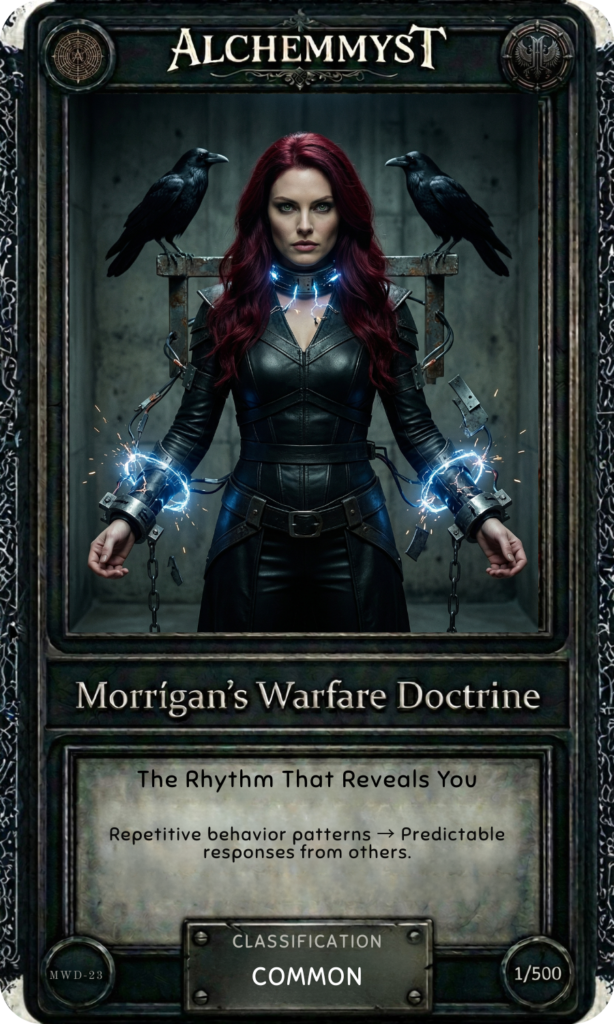
The Channel Hidden in Your Cadence
Your rhythm is data. Once modeled, it becomes a channel — a delivery mechanism for inputs timed to arrive when you are most receptive.
Sovereignty disrupts the cadence before it can be used.
Directive: Alter the rhythm of one recurring task today.
Application Directive: Which recurring window of attention, if shifted, would most disrupt the model others have built around your availability?
The Morrígan War Doctrine Truth – (MWD-23)
The Rhythm That Reveals You
Combatting Predictability in the Age of AI
Your rhythm is not just a pattern. It is a channel.
Most people understand, at some level, that what they do can be predicted. They know their habits are visible, their preferences traceable, their responses somewhat foreseeable to anyone who has paid attention long enough. What they do not fully register is that the when of their actions is equally legible — and that the cadence of their behavior, once modeled, becomes something more than a forecast. It becomes a delivery mechanism. A channel through which the right stimulus, inserted at the right moment, produces the expected response.
This is the distinction between MWD-16 (The Danger of Consistent Timing) and MWD-23. MWD-16 addresses timing as a temporal record — the clock you are running for anyone who knows when to be ready for you. MWD-23 addresses what that clock enables: the use of your rhythm as a channel for steering you. The model does not only predict when you will act. It predicts when you will be most receptive, most distracted, most likely to decide quickly, most likely to defer. And it delivers its inputs accordingly.
Your rhythm is data. Data becomes a model. Modeled rhythm becomes a channel for manipulation.
The mechanism is precise. A rhythm is not a single repeated action — it is a recurring structure of attention, energy, and availability. You are not equally present at all times. You have windows of high focus and windows of low resistance. You have moments in the day when you make decisions carefully and moments when you accept the path of least friction. You have patterns of engagement and patterns of withdrawal. All of this is legible to any system — human or algorithmic — that has been watching long enough. And once it is legible, it is usable.
The Morrígan did not move on a schedule. Her appearances in the old texts are not predictable by time or interval — they are unpredictable by design, arriving at moments of transition, of vulnerability, of decision. She did not allow her cadence to be read because a readable cadence is a navigable one. When others cannot map your rhythm, they cannot time their approach. When they cannot time their approach, they cannot optimize for the moment when you are most likely to comply, most likely to be persuaded, most likely to move in the direction they have prepared for you.
The doctrine’s instruction is not to become erratic. It is to introduce deliberate variation into the cadence — to alter the rhythm of one recurring task, one recurring response, one recurring pattern of availability — often enough that the model cannot stabilize. A rhythm with variance is not a rhythm that can be used as a channel. It is a rhythm that requires constant recalibration. And a system that must constantly recalibrate cannot optimize its timing against you.
The challenge is precisely scoped: alter the rhythm of one recurring task today. Not a dramatic restructuring — a single deliberate variation in the cadence of something you do consistently. Respond at a different time. Begin a task at a different interval. Shift the window of availability by an hour. The specific action matters less than the principle it enacts: the rhythm is not fixed, the channel is not reliable, the model must be revised.
This is worth sitting with, because the instinct runs in the opposite direction. Consistency feels like competence. Reliability feels like strength. The person who always responds promptly, always begins work at the same hour, always delivers on the same schedule — that person is organized, professional, dependable. And they are. But they are also, without intending to be, running a clock for every system that has been watching. The cadence that signals competence to one audience signals availability to another. The doctrine does not ask you to abandon the rhythm. It asks you to own it — to introduce enough deliberate variation that the cadence remains yours rather than becoming infrastructure for someone else’s timing.
What you will notice, if you pay attention, is that the variation costs you almost nothing in practical terms. The task still gets done. The response still arrives. The work still moves. What changes is the signal the variation sends to every system — human or otherwise — that had been timing its inputs against your cadence. The channel is disrupted. The model is incomplete. The next approach must be made without the advantage of knowing exactly when you will be ready to receive it.
The Closing Directive: Alter the rhythm of one recurring task today.
The Vantage Point
From here, you can see the cadence you had been running. Not a schedule you chose — a rhythm that had formed through repetition, stabilized through habit, and become legible to every system that had been watching. The recurring task, the consistent window, the predictable interval of attention and availability. All of it producing a signal that told others exactly when to be ready for you.
The altered rhythm is visible from here too. One variation in the cadence — one moment where the channel did not deliver on schedule. The model required revision. The next approach could not be timed with the same precision. The rhythm is still yours.
What changed is that it is no longer a reliable map for anyone else.