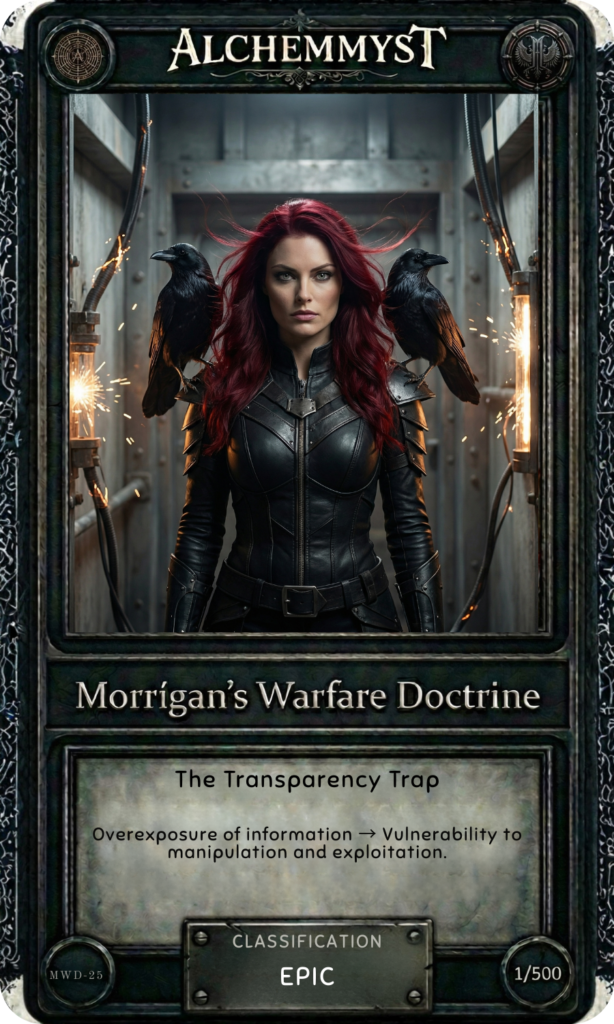
The Transparency Trap
Openness without strategy is not honesty — it is an unlocked door.
Reveal what serves you. Conceal what hands away leverage.
Directive: Withhold one procedural detail you normally share. Note the discomfort of the silence.
Application Directive: Which part of your process, if withheld, would most disrupt the ability of others to anticipate your next move?
The Morrígan War Doctrine Truth – (MWD-25)
The Transparency Trap
Combatting Predictability in the Age of AI
The most dangerous thing you reveal is never the truth itself — it’s how you operate.
Transparency has been sold as a virtue so consistently, for so long, that most people have stopped questioning what it costs. Be open. Be clear. Show your work. Let people in. These are the instructions given to anyone who wants to be trusted, respected, or understood. And they are not wrong — in the right context, with the right audience, transparency builds connection and credibility.
But there is a version of transparency that has nothing to do with connection. It is the kind that hands over your operating system before anyone has earned access. The kind that narrates your process, explains your method, walks others through your sequence of decisions — not because the situation requires it, but because openness has become a reflex. And a reflex, as the doctrine has established repeatedly, is a pattern. And a pattern is a map.
Excess transparency hands the world your operating system. An exposed operating system is easier to debug and control.
MWD-25 addresses the layer beneath prior entries: not the explanation of a single decision, not the repeated justification that becomes a training cycle, but the disclosure of how you operate — your methods, your sequences, your workflow architecture. Not the output. The process itself.
When you show your work habitually, you are not simply being helpful. You are providing a model of how you function. Anyone who has observed that process long enough can begin to predict it — and position themselves within it: ahead of your next step, at the point where your sequence creates a dependency, at the moment when your method produces a gap they can fill on their terms rather than yours.
This is what the doctrine means by “easier to debug and control.” A system whose internal logic is visible can be tested. Its failure points can be identified. Its outputs can be anticipated. Its behavior can be shaped by anyone who understands the inputs well enough to introduce the right ones at the right time. You do not need to be coerced if you can be configured. And the configuration begins with the exposure of the operating system.
The Morrígan’s power was not only in what she did. It was in the fact that no one could fully model how she would do it. Her process was not available for inspection. Her methods were not narrated. Her sequences were not explained in advance. This opacity was not secrecy for its own sake — it was the deliberate preservation of the gap between what others could observe and what they could predict. That gap is leverage. Every time you close it voluntarily, you transfer the leverage.
Selective opacity is not the same as deception. It is not the withholding of truth. It is the recognition that not every process needs to be shared, not every method needs to be explained, and not every sequence needs to be made visible in advance. You can be honest without being transparent about everything. You can be trustworthy without narrating your workflow. The output can be clear without the process being a public document. The result is what others are entitled to see. The architecture that produced it belongs to you.
The challenge is calibrated to this: withhold one procedural detail you normally share. Not a significant secret — a routine disclosure, the kind you offer as a matter of habit rather than necessity. Notice the pull toward the explanation. Notice the discomfort of leaving the process unnarrated. That discomfort is the signal that the transparency had become automatic — a conditioned offering that was no longer serving you, only the model others were building of how you work.
This is worth sitting with, because the cultural pressure runs hard in the opposite direction. Transparency is framed as accountability. Showing your work is framed as integrity. And in the right contexts, with the right audience, all of that is true. The doctrine is not arguing against transparency. It is arguing against the reflex — the automatic, unexamined disclosure of process that happens before you have assessed whether the context requires it, whether the audience has earned it, and whether the visibility serves you or only the model others are building at your expense. Selective opacity is a skill, not a posture. The load-bearing disclosures stay. The habitual ones get examined. The ones running on automatic — the procedural details shared not because they serve the situation but because you have always shared them — those are the ones the doctrine asks you to reclaim.
The Closing Directive
Withhold one procedural detail today. Let the output stand without the process being visible. Notice who asks — and what the asking reveals about how much they had been relying on the narration.
The Vantage Point
You are standing outside your own process for the first time, looking at it as others have. The sequence is visible. The method is clear. The steps are legible in the order you always follow them. And from this vantage point, you can see what you could not see from inside: the entry points, the dependencies, the moments where the process creates a predictable gap. You have been narrating all of this, in detail, as a matter of habit. Not because anyone required it. Because openness had become the default, and the default, as the doctrine teaches, is never neutral. It is always serving something. The question is whether it is serving you.