Practice Being Unfamiliar
Expect the unexpected to gain the upper hand.
Familiarity breeds vulnerability.
Directive: Introduce deliberate variations before repetition gives others leverage.
Application Question: Where are you easiest to anticipate?
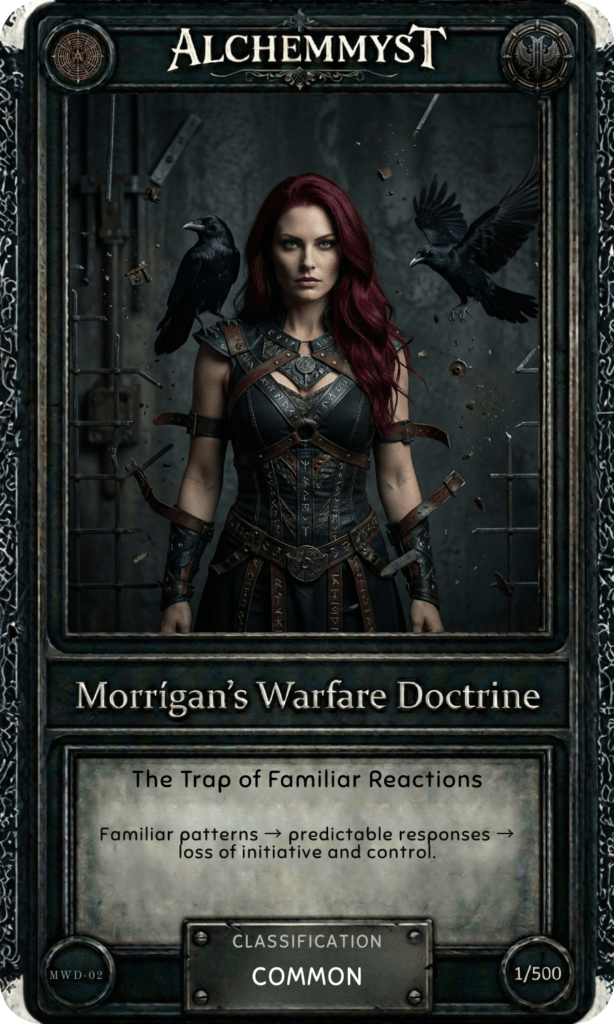
The Morrígan War Doctrine – MWD-02
The Trap of Familiar Reactions
Combatting Predictability in the Age of AI
You are not reacting.
You are reporting.
Every time a familiar trigger arrives, and you respond the same way, you are confirming a model. The system did not need to force anything from you. It only needed to wait.
The Anatomy of the First Reaction
The first reaction feels like instinct. It arrives fast, it feels true, and it carries the full weight of certainty behind it. But instinct and first reaction are not the same thing, and the difference between them is where your sovereignty either holds or collapses.
Instinct is biological. It is the flinch before the flame, the catch before the fall. It belongs to the body and it serves survival. The first reaction is something else entirely. It is biographical. It is the accumulated residue of every time you responded to this kind of moment in this kind of way. It is a groove worn into your behavior by repetition, not by nature. And because it was built by repetition, it can be interrupted by choice.
The first reaction is not who you are. It is who you have been, rehearsing itself on cue.
What the System Receives
When you deliver that reaction — the familiar anger, the reflexive apology, the automatic withdrawal — something receives it. A person reads you. An algorithm updates its model. A dynamic locks into place. None of these receivers need to overpower you. They only need you to stay consistent.
What they receive is not just your response. They receive confirmation that the range of your behavior is known. They receive evidence that the trigger works. They receive the assurance that next time, the same input will produce the same output. You have just made yourself cheaper to manage. Not through weakness, but through legibility. The reaction that felt like self-expression was, in functional terms, a report filed on your own behalf.
This is not paranoia. It is mechanics. And understanding the mechanics is the first act of refusal.
The Morrígan Principle: The Pause as Power
The Morrígan never arrived in the form the battlefield expected. Not because she was chaotic, but because she understood that the expected form had already been prepared for. She chose her shape. That choice — deliberate, precise, made in the space between what provoked her and what she became — is the doctrine’s central act.
The pause is that space. It is not hesitation. It is not weakness dressed in patience. It is the only moment in any triggered exchange where you are completely sovereign. Before the pause, the trigger has momentum. After the pause, you have chosen. In the pause itself, the pattern has not yet completed — and an incomplete pattern cannot be modeled.
This is where the Morrígan’s lesson becomes immediately practical. The pause does not require a new personality or a different life. It requires only the recognition that the first reaction is a door, and you are not obligated to walk through it simply because it opened. In that window, you are not suppressing yourself. You are selecting yourself. There is a version of you that the moment did not prepare for. The pause is how you find it.
The Cost of Staying in the Groove
The price of never breaking the first reaction is not dramatic. It does not arrive as a single catastrophic loss. It accumulates quietly, the way a river narrows over years of the same current cutting the same path. Your range shrinks. Your leverage diminishes. The people and systems around you stop being surprised by you, and when surprise is gone, so is a significant portion of your power. You become, gradually and without noticing, a version of yourself that is easier to manage than you were before.
That is the real cost. Not defeat. Reduction.
The Closing Directive
Know your first reaction well enough to own it — and own it well enough to withhold it when the moment demands something the system has not yet seen from you.
That is the shape the Morrígan would choose.
Vantage Point
Standing here, you can finally see the shape of the reaction you just refused to give. The groove that felt like instinct — the automatic anger, the reflexive apology, the withdrawal that arrived before you had time to choose it — is visible now for what it always was: a channel worn by repetition, not by nature. From this position, you can see the split second where the other person paused, recalibrated, waited for the data point you withheld. The model ran. It just ran without you in it. That pause — that small, unresolved silence — is the first evidence that you are no longer providing the fuel the script needs to function.