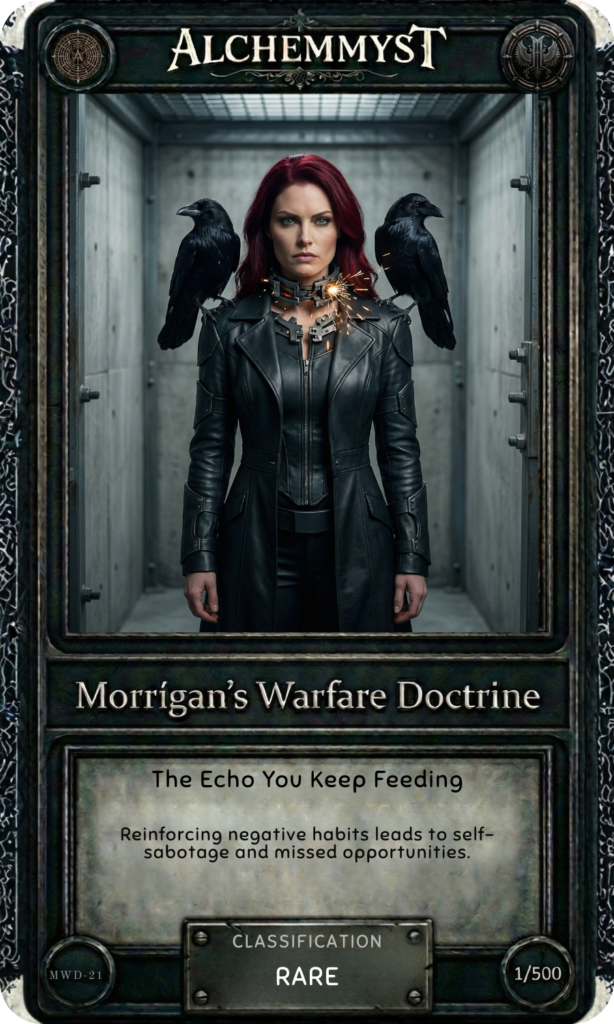
The Echo Chamber
Every repeated justification confirms a template. A confirmed template is a lever into your decision logic.
The explanation was always optional. The echo is not.
Directive: Give one action today without the usual explanation. Let it stand without narration.
Application Directive: What is the justification you have rehearsed most often — and who has learned to expect it?
The Morrígan War Doctrine Truth – (MWD-21)
The Echo You Keep Feeding
Combatting Predictability in the Age of AI
The justification you keep repeating is not a defense. It is a training document.
Every time you offer the same explanation for the same kind of decision, you are not simply accounting for your behavior. You are teaching whoever is listening how your decision logic works — what inputs produce what outputs, what conditions generate what responses, what you will do the next time the situation looks familiar. The explanation feels like closure. It is actually a template.
This is the precise mechanism MWD-21 addresses — and it is distinct from MWD-15 (The Trap of Over-Explaining) in a specific way. MWD-15 addressed the single act of over-explanation: the voluntary narration of your decision architecture in one instance, handing over the blueprint before anyone asked. MWD-21 addresses the compounded version: the repeated justification that has been rehearsed enough times to become a script. The echo you keep feeding. The explanation that has been offered so consistently, in so many similar situations, that others have stopped needing to ask for it — they already know what you will say, because you have said it before, and before that, and before that.
The distinction matters because the mechanism is different. A single over-explanation is a disclosure. A repeated justification is a training cycle. Each repetition confirms the template. Each confirmation makes the template more reliable. And a reliable template, in the hands of anyone who has been paying attention, is a lever — a predictable pathway into your decision logic that can be activated by recreating the conditions that reliably produce the explanation.
Repeating the same justification trains others to expect it. Expected justification becomes a lever they can pull.
The Morrígan did not rehearse her reasoning. She did not develop a standard account of her motives that she offered consistently across contexts. Her opacity was not silence for its own sake — it was the deliberate refusal to establish a pattern of explanation that could be modeled, anticipated, and used. When others could not predict what she would say about why she had acted, they could not build a lever from the prediction. The motive remained hers. The decision logic remained uncharted.
This is what the doctrine means by opacity in motive. It is not about deception. It is about denying others the template that repeated justification creates. The action stands. The result is visible. The reasoning that produced it does not need to be narrated — and when it is narrated in the same way, in the same terms, across multiple instances, the narration becomes the most exploitable data point in the entire exchange.
The challenge is calibrated to this. Give one action today without offering the usual explanation. Not a significant decision — a routine one, the kind where you would normally reach for the familiar justification. Let the action stand without the script. Notice the pull toward the explanation — the discomfort of the silence, the impulse to fill it with the rehearsed account. That pull is the echo. It is the trained response to the trained expectation. And the moment you withhold it, you interrupt the training cycle.
The interruption does two things simultaneously. It denies the listener the confirmation they were expecting — the next data point that would have reinforced the template. And it restores your awareness that the explanation was always optional. The action did not require the justification. You had simply offered it so many times that the offering had become automatic — a conditioned response to a conditioned expectation, running beneath the threshold of deliberate choice.
There is a third effect that the doctrine values as much as the first two. When the script is withheld, the silence that follows is informative. The discomfort of that silence — the pull toward filling it with the familiar justification — reveals how deeply the echo has been trained. A pull you barely notice is a pattern that has been running long enough to feel like gravity. An almost irresistible pull is a pattern that has been running long enough to become structural. Either way, the silence makes the echo visible in a way that feeding it never could. You cannot examine a pattern you are actively executing. You can only examine it from the outside — and withholding the script, for one instance, puts you briefly on the outside of a loop you have been inside of long enough to mistake for the shape of things.
The Closing Directive: Give one action today without offering the usual explanation. Let the action stand.
The Vantage Point
From here, you can see the echo chamber you built. Not through deception or manipulation — through repetition. The same explanation, offered in the same terms, across enough instances that the template became reliable. Others stopped needing to ask. They already knew what you would say. And knowing what you would say, they knew how to recreate the conditions that would produce it.
The withheld explanation is visible from here, too. One instance where the script was not delivered. The silence that followed — not hostile, not confused, simply open. The template, for the first time, is unconfirmed. The lever, for the first time, was pulled without a predictable mechanism. The echo, for the first time, was not fed. What remains is the action itself, standing without narration, belonging entirely to you.